


Child Boating Accident Claims in New York: Safety Rules, Evidence, and Liability

Child boating accident claims in New York may involve recreational boats, rental vessels, personal watercraft, docks, marinas, public launches, unsafe wake, missing life jackets, poor supervision, defective equipment, camp activities, guided tours, drowning injuries, or delayed rescue. These claims require careful review because child injuries often involve safety instructions, adult supervision, equipment fit, and fast-changing water conditions. People reviewing claim options after a child boating injury may use a boating accident lawyer Long Island resource to understand how liability, evidence, insurance, and damages are generally evaluated.
Quick Answer
A child boating accident claim usually depends on how the injury happened, who controlled the boat or location, whether required safety equipment was available, whether the child was properly supervised, whether the operator acted safely, and whether a rental company, marina, camp, tour operator, public entity, vessel owner, or another boater contributed. Important evidence may include accident reports, photos, witness statements, passenger accounts, life jacket evidence, vessel records, rental documents, supervision records, weather data, GPS data, medical records, and insurance documents.
Key Takeaways
Child boating claims may involve vessel operation, adult supervision, life jacket fit, rental company conduct, dock hazards, public property, or product defects.
New York State Parks states that boaters must have one life jacket for each person aboard, and that life jackets must be U.S. Coast Guard-approved, accessible, in good condition, and properly sized.
A personal flotation device must be worn by anyone under 12 in many covered boating situations unless the child is in an enclosed cabin
New York State Parks states that all motorized vessel operators must complete a state-approved safe boating course under Brianna’s Law.
New York personal watercraft rules include age, safety course, life jacket, and equipment requirements that may matter when a child or teen is involved.
New York boating accident reporting rules may require written reporting within five days after qualifying vessel accidents involving injury, death, disappearance under water, or property damage over $1,000.
Public docks, municipal marinas, state facilities, or government-controlled areas may involve shorter notice rules.
Why Child Boating Accident Claims Are Different
Child boating accident claims are different because children depend heavily on adults, operators, property owners, rental companies, guides, camp staff, and other responsible people for safety decisions. A child may not understand boat movement, wake, propeller danger, docking hazards, sudden turns, deep water, current, cold water, or the need to stay seated.
A child boating claim may involve:
Adult supervision
Properly fitted life jackets
Passenger instructions
Safe seating
Operator speed and lookout
Rental company warnings
Camp or guided tour supervision
Dock and marina conditions
Weather decisions
Emergency response
Medical documentation
Insurance coverage
Settlement approval issues
A strong claim usually explains not only what happened, but also which adult, business, vessel owner, operator, or property controller had the ability to prevent the danger.
Common Child Boating Accident Scenarios
Child boating injuries can happen on a moving boat, at a dock, in a marina, during a rental trip, on a personal watercraft, during a camp activity, or while boarding and exiting.
Common scenarios include:
Child passenger thrown during a sudden turn
Child injured by unsafe wake
Child falls overboard
Child slips while boarding or exiting
Child hurt on a marina dock
Child injured in a rental boat accident
Child injured during a camp or guided boating activity
Child struck by another vessel
Child injured on a personal watercraft
Child injured by a defective ladder or railing
Child hurt because of missing or poorly fitted life jacket
Child involved in a drowning or near-drowning incident
Child injured during tubing or towed activity
Child injured near a public launch or swimming area
The exact scenario affects which records are needed and which parties may be responsible.
Life Jacket Rules and Child Safety
Life jacket evidence can be central in child boating claims. New York State Parks states that every motorized or non-motorized vessel, including kayaks, canoes, paddleboards, personal watercraft, specialty craft, and sailboats, must have one life jacket for each person on board. Life jackets must be U.S. Coast Guard-approved, readily accessible, in good condition, and the proper size for the intended wearer. (New York State Parks)
New York State Parks also states that a PFD must be worn by anyone under 12 years of age, unless in an enclosed cabin, when aboard a motorboat under 65 feet or any other pleasure boat, including sailboats, canoes, and kayaks. (New York State Parks)

Life jacket evidence may include:
Whether a life jacket was provided
Whether it was the correct child size
Whether it was worn and fastened
Whether it was damaged, faded, torn, or too loose
Whether it was approved for the activity
Whether the child was told to keep it on
Whether adults checked the fit
Whether a rental company or guide provided it
Whether the life jacket was accessible in an emergency
A life jacket issue may not cause the initial accident, but it can affect the severity of the injury and the outcome after a child enters the water.
Child Passengers on Recreational Boats
A child passenger may be injured when an operator drives too fast, crosses wake unsafely, turns suddenly, fails to warn passengers, allows unsafe seating, or ignores changing water conditions.
Important questions may include:
Where was the child seated?
Was the child wearing a proper life jacket?
Was the child told to remain seated?
Did the operator warn passengers before turning or accelerating?
Was the vessel overloaded?
Did wake or weather affect the boat?
Was alcohol or distraction involved?
Did another vessel create the danger?
Did adults respond quickly after the child was hurt?
New York Navigation Law § 45 requires vessel operators to navigate carefully and prudently, prohibits reckless operation, and bars speed greater than reasonable and prudent under existing conditions and hazards. It also restricts speed within 100 feet of shore, docks, piers, rafts, floats, and anchored or moored vessels in many circumstances.
Operator Negligence in Child Boating Claims
The vessel operator is often one of the first parties reviewed after a child boating injury. The operator may be a parent, relative, family friend, renter, charter captain, camp employee, tour guide, or another boater.
Operator negligence may involve:
Excessive speed
Reckless turns
Poor lookout
Distracted operation
Boating while impaired
Unsafe wake
Failure to slow near docks or shore
Failure to warn passengers
Failure to supervise child passengers
Allowing a child to sit in an unsafe area
Ignoring weather or visibility concerns
Failure to carry proper safety equipment
Delayed response after a child falls overboard
Operator conduct should be evaluated with the full timeline, not assumptions. Passenger statements, adult witness accounts, GPS data, accident reports, photos, and medical records may help show what happened.
Vessel Owner Liability
The person operating the boat may not be the owner. A child may be injured on a boat owned by a friend, relative, rental company, marina, business, camp, guide service, or private owner.
New York Navigation Law § 48 states that a vessel owner may be liable for death or injuries resulting from negligent use or operation by someone using or operating the vessel with the owner’s express or implied permission.
Owner-related questions may include:
Who owned the vessel?
Did the operator have permission?
Was permission express or implied?
Did the owner know children would be aboard?
Did the owner provide proper life jackets?
Was the vessel maintained?
Was the operator experienced?
Was the vessel insured?
Was the boat used privately, commercially, or as a rental?
Did the owner know the operator was impaired or unsafe?
Ownership and permission evidence may affect both liability and available insurance coverage.
Personal Watercraft Accidents Involving Children or Teens
Personal watercraft can create serious injury risks because they move quickly, turn sharply, and offer little physical protection. Child and teen claims may involve rider ejection, passenger ejection, collision, unsafe wake, rental instruction, life jacket use, lanyard use, or operation too close to docks, swimmers, or other vessels.
New York State Parks states that personal watercraft operators must be 14 or older, all operators must complete a safe boating course, operation after dusk and before dawn is prohibited, and operators and passengers must wear properly sized U.S. Coast Guard-approved life jackets intended for personal watercraft use. (New York State Parks)
Personal watercraft evidence may include:
Operator age
Safe boating certificate
Life jacket fit
Engine cut-off lanyard use
Rental records
Instruction forms
Passenger statements
Witness accounts
GPS or tracking data
Photos of the craft and safety equipment
Medical records
Insurance documents
A related boat accident attorney guide may help readers understand why personal watercraft claims often require review of operator conduct, rental records, safety equipment, and insurance coverage.
Rental Boat and Rental Equipment Claims
Rental boat claims may involve motorboats, pontoons, kayaks, canoes, paddleboards, or personal watercraft. A rental company is not automatically responsible for every accident, but its conduct may matter when the claim involves unsafe equipment, missing child-sized life jackets, poor instruction, lack of warnings, weather decisions, or incomplete records.
Rental-related issues may include:
Child-sized life jacket not provided
Life jacket provided but not properly fitted
Unsafe vessel condition
Poor rental instruction
Lack of warnings about currents or no-wake areas
Rental to an unqualified operator
Poor supervision at launch or return
Missing safety checklist
Defective paddlecraft or personal watercraft
Failure to explain emergency procedures
Failure to preserve rental records
Rental evidence may include agreements, safety checklists, age and identification records, instruction forms, staff statements, maintenance logs, incident reports, photos, GPS data, and insurance documents.
Camp, School, and Guided Activity Claims
Some child boating accidents happen during summer camp, school trips, guided kayaking, sailing programs, fishing trips, hotel outings, youth programs, or organized recreational activities. These claims may involve supervision, staff training, safety planning, equipment checks, and emergency response.

Important questions may include:
Who supervised the child?
What was the child’s age and skill level?
Were parents given activity information?
Were life jackets fitted and checked?
Was the route appropriate?
Were weather and water conditions reviewed?
Were staff trained for emergencies?
Was the group size reasonable?
Was the child told where to sit or paddle?
Was there a rescue plan?
Were incident reports completed?
Were medical needs handled promptly?
A guided activity claim may require participant lists, waivers, staff schedules, safety policies, instruction records, emergency response records, and witness statements.
Kayak, Canoe, and Paddleboard Accidents Involving Children
Children may be injured in kayaks, canoes, and paddleboards because these vessels are smaller, lower in the water, and more vulnerable to wake, wind, current, and visibility problems.
New York State Parks states that there is no minimum age in New York for a child to legally operate a manually propelled boat, but children operating paddle or sail craft should be mature enough to remain seated, float while wearing a life jacket, and understand not to lean over the sides. It also states that children under 12 must always wear a properly sized U.S. Coast Guard-approved life jacket in a boat. (New York State Parks)
Paddlecraft child injury claims may involve:
Unsafe wake from a motorboat
Poorly fitted life jacket
Strong current or wind
Rental company instruction problems
Child separated from kayak or paddleboard
Defective paddle or vessel
Lack of adult supervision
Drowning or near-drowning risk
Public launch or dock hazards
Evidence should focus on vessel condition, water conditions, supervision, visibility, life jacket fit, and the conduct of nearby motorized vessels.
Dock, Marina, and Public Launch Injuries
Children can be injured before the boat ever leaves the dock. A child may slip on a wet walkway, trip over a rope, fall from a floating dock, step into a gap between the dock and vessel, or be hurt at a crowded rental area.
Dock and marina hazards may include:
Slippery boards
Broken dock sections
Loose ropes
Poor lighting
Unstable gangways
Missing handrails
Fuel or oil residue
Unmarked edges
Unsafe ladders
Crowded launch areas
Poor staff assistance
Unsafe rental staging zones
A premises liability attorney resource may help explain how property control, inspection records, maintenance practices, and notice evidence can overlap with child boating and waterfront injury claims.
Drowning and Near-Drowning Claims Involving Children
Drowning and near-drowning claims involving children require fast evidence preservation and careful medical documentation. A child may fall overboard, capsize, slip from a dock, be thrown from a personal watercraft, become separated from a paddlecraft, or enter deep water during a supervised activity.
Drowning-related evidence may include:
Life jacket fit and condition
Adult supervision records
Passenger statements
Witness accounts
Emergency response timeline
911 records
Rescue records
Weather and water conditions
Vessel speed and position
Dock or launch conditions
Medical records
Hospital records
Follow-up care records
In nonfatal drowning cases, medical records may be important because serious effects can involve breathing complications, oxygen deprivation concerns, neurological evaluation, hospitalization, or long-term rehabilitation.
Defective Equipment and Product Issues
Some child boating injuries involve defective or poorly maintained equipment. A life jacket may be damaged, a ladder may fail, a railing may break, a kayak may leak, a seat may come loose, or a personal watercraft control may malfunction.
Defect-related issues may include:
Defective child life jacket
Incorrect life jacket size or labeling
Broken ladder
Loose railing
Defective seat
Defective paddlecraft
Steering failure
Throttle malfunction
Engine cut-off device failure
Poor repair work
Missing warnings or instructions
If defect or maintenance failure is suspected, the equipment should be preserved before repair or replacement. Photos, product labels, maintenance records, repair invoices, prior complaints, and expert inspection may be important.
Evidence That Can Strengthen a Child Boating Claim
Child boating claims often depend on records held by adults, operators, rental companies, camps, marinas, insurers, or public agencies. Evidence should be gathered early because boats may be repaired, footage may be overwritten, and witness memories may fade.
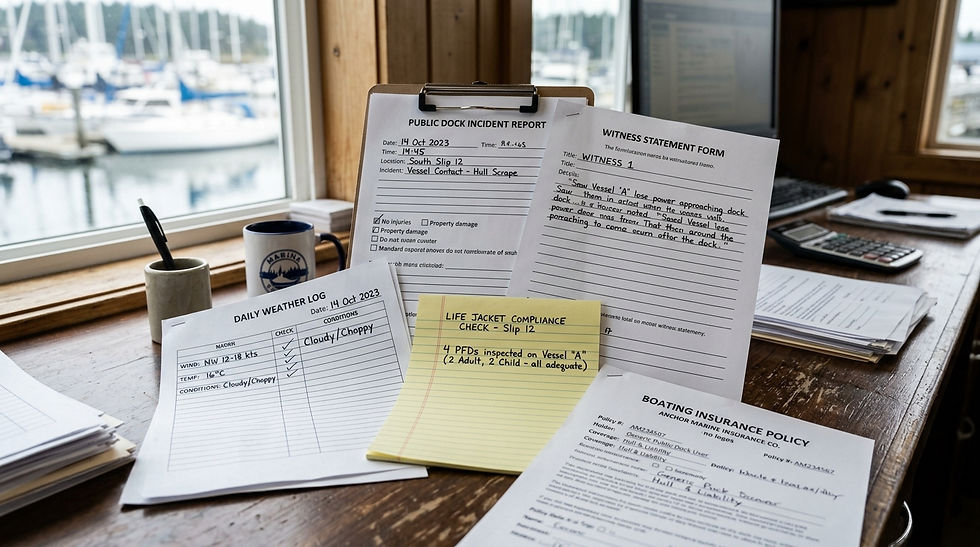
Helpful evidence may include:
Boating accident report
Incident report
Photos of the vessel
Photos of dock or marina conditions
Photos of life jackets and safety equipment
Child-sized life jacket evidence
Passenger statements
Adult witness statements
Operator information
Vessel owner information
Vessel registration records
Rental agreements
Camp or guided activity records
Supervision records
Safety instruction forms
Maintenance logs
GPS or route data
Weather and water condition records
Emergency response records
Medical records
Insurance documents
For broader documentation planning, readers may review how evidence for personal injury claims can help connect accident facts, injury, responsible parties, and damages.
Accident Reporting After a Child Boating Injury
A child boating injury may need to be reported if it meets New York reporting requirements. New York Navigation Law § 47-B requires a written report within five days when a vessel accident involves death, injury, disappearance under water, or property damage to any one person over $1,000.
New York State Parks also states that boating accidents must be reported within five days when the accident results in injury requiring medical care beyond basic first aid, death or disappearance, or property damage to any one party over $1,000.
A report may help document:
Date and time
Waterway or marina location
Vessel operator
Vessel owner
Child passenger information
Injury details
Property damage
Weather and water conditions
Witnesses
Emergency response
Law enforcement involvement
The report is not the full claim, but it can create an important official record.
Medical Records and Child Injury Documentation
Medical care should come first after a child boating injury. Children may have difficulty explaining pain, dizziness, fear, breathing problems, or functional limitations, so medical documentation can be especially important.
Medical records may include:
Emergency medical services records
Emergency room records
Hospital records
Pediatric records
Imaging reports
Specialist notes
Surgery records
Therapy records
Wound care records
Psychological care records
Prescription records
Follow-up care instructions
Future care recommendations
Child injury documentation may also include school absence records, activity restrictions, caregiving notes, therapy attendance, and records showing how the injury affected normal childhood activities.
Insurance Coverage in Child Boating Claims
Insurance coverage may depend on who caused the accident and where it happened. A private boat injury may involve boat owner coverage. A rental accident may involve rental company insurance. A dock fall may involve marina or property insurance. A guided trip may involve commercial coverage. A defective product claim may involve product liability coverage.
Potential insurance sources may include:
Boat insurance
Vessel owner policy
Homeowner’s insurance
Umbrella coverage
Rental company insurance
Marina liability insurance
Camp or guided activity insurance
Charter or commercial vessel coverage
Product liability coverage
Public entity coverage in limited cases
Insurance companies may dispute supervision, life jacket use, operator permission, comparative fault, policy exclusions, injury severity, or whether a specific policy applies.
Child Settlements and Court Approval Issues
Child injury claims can involve additional settlement procedures. New York Courts Rule 202.67 states that settlement of an action or claim by an infant or judicially declared incapacitated person must comply with CPLR 1207 and 1208, and it describes applications for approval of an infant’s compromise. (New York Courts)
This means a child injury settlement may require more than a signature from a parent or guardian. Medical records, settlement terms, attorney fee information, proposed fund handling, and court review may become part of the process. The exact procedure depends on the claim, venue, settlement structure, and court requirements.
Comparative Fault and Supervision Arguments
Defendants and insurers may raise blame arguments in child boating claims. They may claim an adult failed to supervise, the child ignored instructions, the child removed a life jacket, another passenger caused the incident, or a parent accepted a known risk.
These arguments do not automatically defeat a claim. Important follow-up questions include:
Were instructions clear and age-appropriate?
Was the child old enough to understand the risk?
Was a proper life jacket provided and fitted?
Did adults check the life jacket?
Did the operator drive safely?
Did a rental company provide adequate warnings?
Was the child placed in an unsafe seating area?
Did weather, wake, or vessel movement create sudden danger?
Did a dock or marina hazard contribute?
Was the supervising adult employed by a camp, guide, school, or business?
Child-related fault arguments should be evaluated carefully because children do not have the same judgment, awareness, or risk evaluation as adults.
Public Entity Issues
Some child boating injuries involve public docks, municipal marinas, public launches, state parks, public vessels, public camps, public schools, or government-controlled waterfront areas. These claims may involve special notice rules.
New York General Municipal Law § 50-E generally requires a notice of claim within 90 days when notice is required for certain tort claims against public corporations. The notice must include information such as the nature of the claim, time, place, manner in which it arose, and claimed injuries or damages as far as practicable.
Public entity evidence may include:
Exact location
Public agency name
Facility signage
Program records
Camp or school records
Incident reports
Supervision records
Dock or launch maintenance records
Prior complaints
Photos of the hazard
Witness statements
Surveillance footage
The exact location should be documented early because public entity deadlines may arrive quickly.
Deadlines for Child Boating Accident Claims
Deadlines depend on the claim type, responsible party, injury type, and whether a public entity is involved. The New York Courts statute of limitations timetable lists three years for many negligence-based personal injury claims, two years for wrongful death claims, and three years for product liability matters. (New York Courts)
Child claims may involve additional timing issues, but no one should assume that a child’s age removes all urgency. Accident reports, insurance notice, public entity notice rules, surveillance footage, rental records, vessel repairs, GPS data, and witness memories can create practical deadlines long before a lawsuit deadline.
Common Mistakes After a Child Boating Accident
Some mistakes can make a child boating claim harder to prove.
Common mistakes include:
Not getting medical care promptly
Not reporting a qualifying boating accident
Not identifying the operator and vessel owner
Not photographing the vessel, dock, or safety equipment
Not saving the child’s life jacket
Not checking the size and condition of the life jacket
Not collecting passenger and witness information
Not preserving rental, camp, or guided activity records
Not documenting weather, wake, or water conditions
Not requesting surveillance footage quickly
Allowing the vessel or equipment to be repaired before inspection
Giving broad insurance statements before facts are clear
Accepting a quick settlement before injuries are fully known
Missing public entity notice deadlines
A strong claim usually depends on prompt medical care, preserved equipment, photos, reports, witness statements, and organized records.
When Legal Guidance May Be Useful
Legal guidance may be useful when a child boating accident involves serious injury, drowning risk, missing life jackets, rental boats, personal watercraft, camps, guided activities, public docks, defective equipment, disputed supervision, or unclear insurance coverage.
A child boating claim may require review of vessel operation, owner permission, adult supervision, life jacket evidence, rental records, camp policies, accident reports, medical records, insurance coverage, public entity rules, settlement approval procedures, and deadlines.
People researching local support may review a Farmingdale legal office location when looking for Long Island child boating accident claim information. Publicly available personal injury case results may provide general context, although every claim depends on its own facts, evidence, injuries, insurance coverage, and applicable law.
FAQs About Child Boating Accident Claims
Can a child have a boating accident claim in New York?
Yes. A child may have a claim when negligent vessel operation, unsafe supervision, missing safety equipment, rental company conduct, marina hazards, defective equipment, or another party’s conduct caused or contributed to the injury.
Are life jackets required for children on boats in New York?
New York State Parks states that a PFD must be worn by anyone under 12 unless in an enclosed cabin when aboard a motorboat under 65 feet or another pleasure boat, including sailboats, canoes, and kayaks. The PFD should be properly sized and in good condition. (New York State Parks)
Who can be liable for a child boating injury?
Potentially responsible parties may include the boat operator, vessel owner, rental company, marina, dock owner, camp, guide service, charter operator, another boater, maintenance provider, product manufacturer, or public entity depending on the facts.
What evidence matters after a child boating accident?
Important evidence may include photos, accident reports, witness statements, life jacket evidence, passenger accounts, operator and owner information, rental records, camp or supervision records, weather data, GPS records, medical records, and insurance documents.
Can a child boating settlement require court approval?
Yes, child injury settlements may involve special approval procedures. New York Courts Rule 202.67 addresses settlements of claims by infants and references CPLR 1207 and 1208 procedures for compromise applications. (New York Courts)
Final Thoughts
Child boating accident claims in New York require careful review because the injury may involve adult supervision, vessel operation, life jacket fit, rental practices, camp procedures, public property, defective equipment, or emergency response. The strongest claims usually depend on prompt medical care, preserved life jacket evidence, accident reports, photos, witness statements, vessel records, supervision records, insurance review, and a clear timeline showing how the child was injured and who had responsibility for safety.


Comments