


What Should Healthcare Professionals Look for in Stain-Resistant Scrubs?

Stain-resistant scrubs should be evaluated by more than a product label or fabric description. Healthcare professionals need to consider how the material handles common surface contact, whether the garment is easy to care for, how the fabric feels during movement, and whether repeated laundering fits the workwear routine.
Performance-oriented workwear such as Epic performance scrubs can be considered within a broader evaluation of fabric behavior, stretch, garment fit, and maintenance. Stain resistance may be useful, but it should support everyday workwear needs rather than replace appropriate hygiene procedures, protective clothing, or workplace safety requirements.
Quick Answer
When evaluating stain-resistant medical scrubs, look for:
Fabric behavior: Consider whether the material is designed to resist rapid surface absorption or help common substances release during cleaning.
Easy care: Review washing and drying instructions before buying.
Stretch and recovery: The garment should still support bending, reaching, sitting, and walking.
Fabric weight: A stain-resistant feature should not automatically make the scrubs unnecessarily heavy or rigid.
Durability: Consider how the textile and garment construction suit frequent workwear use.
Fit: Proper fit remains essential even when the fabric includes performance characteristics.
Workplace requirements: Stain-resistant scrubs do not replace PPE or infection-control procedures.
The most practical stain-resistant scrubs balance fabric performance, movement, comfort, and realistic care needs.
What does stain resistance mean in medical scrubs?
Stain resistance generally describes a fabric or garment characteristic intended to make certain substances less likely to remain visibly embedded in the material.
That does not mean the garment is stain-proof.
Different substances behave differently on fabric. A liquid, oil-based material, cosmetic product, food stain, or environmental soil may interact with a textile in different ways.
Fabric performance can also be affected by:
Fiber composition
Textile construction
Surface characteristics
Fabric finishing
Garment care
Substance type
Length of contact
A stain-resistant fabric may provide extra time before some substances penetrate deeply or may make certain marks easier to remove during appropriate laundering.
However, no healthcare professional should assume that every substance will simply roll off the garment.
Stain resistance is not the same as waterproofing
These terms should not be used interchangeably.
A fabric described as stain resistant may be designed to manage certain everyday spills or surface contact.
A waterproof or liquid-barrier material serves a different purpose.
Healthcare workers should not treat ordinary scrub fabric as a protective barrier against occupational exposure unless the garment has specifically been selected and approved for that purpose.
OSHA explains that personal protective equipment is intended to minimize exposure to workplace hazards.
Ordinary medical scrubs should therefore be evaluated as workwear, not as a substitute for hazard-specific protective clothing.
Why might stain resistance matter in healthcare workwear?
Healthcare professionals work in environments where clothing can encounter a range of everyday substances.
Depending on the role, these may include:
Food or beverages
Cosmetic products
Cleaning-related contact
Environmental soil
Animal hair and debris
Routine workplace spills
The exact exposure pattern varies greatly between jobs.
A dental professional may have different workwear concerns from a veterinarian. A nurse working in a hospital may have a different routine from someone in an outpatient office.
Stain resistance can be useful because visible marks may affect how workwear looks during the day.
However, a professional appearance is only one consideration.
The garment must still provide:
Comfortable movement
Appropriate fabric weight
Useful pockets
Practical fit
Suitable care requirements
A stain-resistant feature should complement the complete scrub design.
How should healthcare professionals evaluate stain-resistant fabric?
A fabric label or collection description can provide useful information, but the garment should be evaluated as a complete textile system.
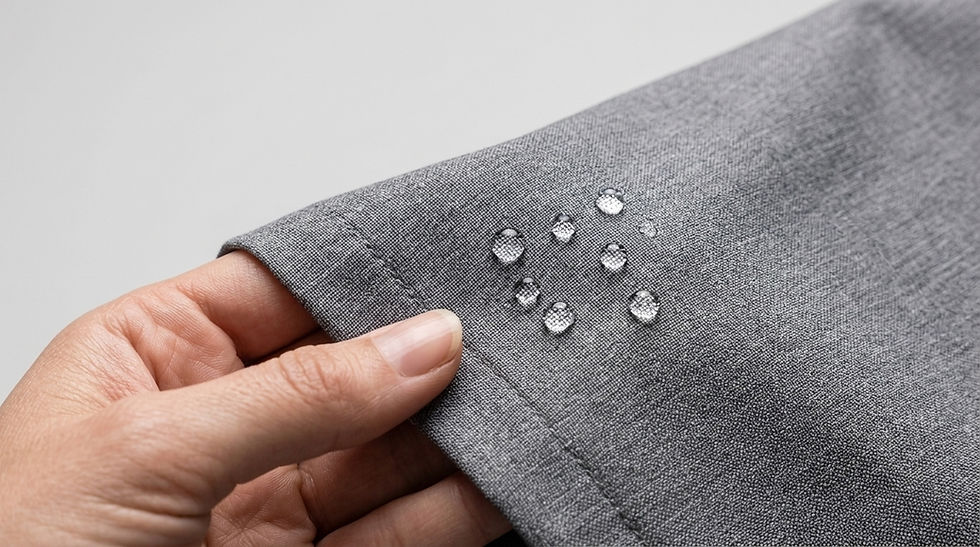
Several characteristics matter.
Start with the fiber blend
Medical scrubs may contain:
Polyester
Recycled polyester
Rayon
Spandex
Cotton
Blends of several fibers
Fiber content can influence the textile, but it does not explain every finished-fabric characteristic.
Two polyester-based scrub fabrics may feel and perform differently because of differences in:
Weave or textile construction
Surface finishing
Fabric weight
Stretch fibers
Additional blended materials
Healthcare professionals should therefore avoid judging stain resistance from one fiber name alone.
Check the fabric surface
Some performance fabrics have a smoother surface feel.
Others may have a softer or more textured finish.
The surface can influence how the garment feels and how certain substances interact with the material.
When possible, examine the fabric closely.
Notice whether it feels:
Smooth
Soft
Crisp
Textured
Lightweight
Structured
Surface feel does not prove stain resistance, but it is part of the complete fabric evaluation.
Consider how quickly substances may absorb
A fabric designed to resist certain surface stains may slow the immediate absorption of some liquids.
This can make prompt blotting or garment care more practical.
However, the behavior will depend on the substance and fabric.
Healthcare professionals should follow the garment's care instructions rather than assuming a particular stain-removal method is always safe.
Is stain resistance the same as fluid resistance?
No.
This distinction is particularly important in healthcare.
Stain resistance is generally a workwear or garment-care characteristic.
Fluid-resistant or protective clothing may be selected for occupational hazard control.
NIOSH separately discusses protective clothing used in healthcare, including clothing intended to help protect healthcare workers from certain biological-fluid exposures.
Ordinary scrubs, even when they offer useful performance features, should not automatically be treated as protective clothing.
Scrubs are not automatically PPE
OSHA has distinguished ordinary uniforms and scrubs worn similarly to street clothing from personal protective equipment in its bloodborne pathogens interpretation guidance.
This means a stain-resistant scrub fabric should not be selected as a replacement for:
Protective gowns
Coveralls
Aprons
Gloves
Other required PPE
The appropriate protective equipment depends on the workplace hazard and employer procedures.
How does fabric stretch affect stain-resistant scrubs?
Performance fabric should still support movement.

Healthcare professionals may repeatedly:
Bend
Reach
Sit
Walk
Squat
Move between work areas
A stain-resistant feature is less useful if the garment feels restrictive during normal work.
Stretch should work with the garment cut
Stretch fabric can provide additional flexibility.
However, proper fit is still necessary.
A scrub top that is significantly too tight through the shoulders may remain restrictive even when the fabric stretches.
Likewise, pants with insufficient room through the hips or thighs may not provide ideal movement simply because the material contains spandex.
The garment should be tested through realistic movements.
Recovery also matters
Recovery describes how well a fabric returns toward its previous shape after stretching.
Medical scrubs may experience repeated tension around:
Knees
Hips
Elbows
Shoulders
Waist
A practical performance fabric should be evaluated for both movement and how the garment behaves after repeated stretching.
Should stain-resistant scrubs also be lightweight?
That depends on the wearer and workplace.
Lightweight scrubs may appeal to healthcare professionals who:
Move frequently
Work in warm environments
Prefer less garment weight
Regularly layer with scrub jackets
However, the lightest fabric is not automatically the best fabric.
Some wearers prefer more structure.
The most useful approach is to consider stain resistance together with:
Fabric weight
Stretch
Drape
Workplace temperature
Activity level
A shopper reviewing different medical scrub collections can compare collections according to their overall fabric and workwear priorities rather than focusing on one feature alone.
Does fabric drape matter in performance scrubs?
Yes.
Drape describes how fabric hangs and moves around the body.
A softer fabric may move fluidly around the torso or legs.
A more structured material may maintain firmer garment lines.
Stain resistance does not automatically determine drape.
Healthcare professionals should evaluate the garment while:
Standing
Walking
Sitting
Bending
Turning
Watch how the fabric moves.
The preferred drape depends on body proportions, garment silhouette, and personal comfort.
How should stain-resistant scrub tops fit?
A scrub top should provide practical room through the shoulders, upper back, and torso.
Test the garment by:
Reaching both arms forward
Raising the arms
Crossing the arms
Sitting
Leaning forward
The top should not create severe pulling.
Top length is also important
A top that rides upward repeatedly may require constant adjustment.
An excessively long garment may create additional bulk around the hips.
Consider the relationship between:
Torso length
Pant rise
Garment silhouette
Tuck-in or untucked design
Fabric performance cannot compensate for an unsuitable top length.
How should stain-resistant scrub pants fit?
Scrub pants should support movement through the waist, hips, thighs, and knees.
The wearer should:
Sit
Walk
Take a long step
Bend the knees
Perform a shallow squat
Check whether the waistband remains secure.
Also notice severe pulling through the hips or thighs.
Pant silhouette affects the wearing experience
Performance scrub pants may be available in silhouettes such as:
Joggers
Tapered pants
Flare pants
Wide-leg designs
More traditional workwear cuts
The correct silhouette depends on fit preference and workplace requirements.
Stain resistance should not be the only factor in the decision.
Can stain-resistant scrubs help veterinary professionals?
Veterinary professionals may have specific workwear concerns related to animal environments.
Depending on the role, clothing may encounter:
Pet hair
Lint
Environmental debris
Routine surface contact
Repeated bending and crouching
A smoother performance fabric may appeal to workers who want workwear that is practical to maintain.
However, pet hair behavior, stain resistance, and protective clothing are separate considerations.
Veterinary professionals should still evaluate:
Stretch
Pant mobility
Pocket security
Garment care
Workplace safety procedures
Performance fabric should suit the complete job.
Are stain-resistant scrubs useful for nurses?
Nurses may work extended or nonstandard schedules and perform repeated movement.
NIOSH provides resources addressing shift work and long hours for nurses.
Stain-resistant workwear may be convenient for nurses who want scrubs that help maintain a neat appearance during the workday.
However, other features may be equally or more important:
Comfortable stretch
Accessible pockets
Secure waistband
Lightweight fabric
Movement-friendly fit
The best scrub choice should balance these characteristics.
What should doctors look for in stain-resistant scrubs?
Doctors should consider their specific work environment.
A physician working in outpatient care may prioritize:
Professional drape
Lightweight comfort
Easy maintenance
Jacket compatibility
Someone working in a more active hospital environment may also prioritize:
Stretch
Pocket function
Movement
Secure pant fit
Stain resistance can be one part of the evaluation, but the scrub set should suit the physician's actual duties.
What should dental professionals consider?
Dental professionals may spend extended periods seated or leaning toward patients.
When evaluating performance scrubs, they should pay attention to:
Shoulder mobility
Upper-back stretch
Waist comfort
Pant rise
Fabric drape
A stain-resistant feature does not correct poor sitting comfort.
The complete garment should be tested while seated.
How should stain-resistant scrubs be cleaned?
Always begin with the garment care label.
The Federal Trade Commission provides information on clothing care instructions through its Care Labeling Rule resources.
Healthcare professionals should review:
Washing instructions
Drying instructions
Temperature recommendations
Bleach guidance
Ironing requirements
Do not assume that aggressive stain-removal products are suitable for every fabric.
Some textile characteristics or finishes may require specific care.
Prompt care may matter
When workplace procedures allow, dealing with an everyday stain promptly may make it easier to clean.
However, workers should distinguish between ordinary garment stains and clothing contaminated during healthcare activities.
The CDC's healthcare laundry and textile guidance discusses uniforms, scrub suits, and healthcare textiles within the broader context of laundry handling.
Facility procedures should be followed for contaminated work clothing.
Do not experiment with unknown cleaning methods
Mixing cleaning chemicals or using products outside garment instructions can damage fabric or create safety concerns.
Follow:
Garment directions
Product instructions
Workplace procedures
Practical fabric care is part of preserving workwear.
Can repeated washing affect stain-resistant performance?
The condition of any workwear can change over time.
Frequent wearing and laundering may affect:
Surface feel
Fabric appearance
Stretch
Garment shape
Waistbands
Seams
How a specific stain-resistant characteristic changes depends on the textile and how it was produced.
Healthcare professionals should follow care instructions and periodically evaluate the garment.
Look for:
Visible wear
Damaged seams
Changes in fit
Waistband problems
Fabric deterioration
A scrub set should be replaced when it no longer functions appropriately for work.
Does wrinkle resistance matter too?
Some healthcare professionals value both stain and wrinkle management.
A fabric that maintains a relatively neat appearance can be useful when work schedules leave limited time for garment preparation.
However, wrinkle resistance should still be considered alongside:
Stretch
Softness
Drape
Fabric weight
Care
The most wrinkle-resistant fabric is not automatically the most comfortable.
The right balance depends on personal priorities.
How can you compare stain-resistant scrub collections?
A structured comparison can prevent one feature from dominating the buying decision.
Compare fabric information
Review:
Fiber composition
Stretch
Fabric weight
Care requirements
Performance descriptions
Compare available garments
Consider whether the collection provides the needed:
Tops
Pants
Jackets
Men's styles
Women's styles
Compare pant silhouettes
Check for the preferred:
Jogger
Tapered
Flare
Wide-leg
Traditional fit
Compare pocket designs
Determine whether storage matches actual work needs.
Compare care requirements
A performance garment should fit the wearer's normal maintenance routine.
How should you test performance scrubs before buying?
A simple movement and fabric test can help.

Step 1: Feel the fabric
Notice the surface texture and weight.
Step 2: Check stretch
Move the arms and legs naturally.
Do not judge the garment by pulling aggressively on the fabric.
Step 3: Sit
Evaluate the waistband, rise, and top length.
Step 4: Reach
Check the shoulders and upper back.
Step 5: Walk and bend
Evaluate pant mobility.
Step 6: Check pockets
Consider normal work items and pocket placement.
Step 7: Review the care label
Confirm that the maintenance instructions are practical.
Performance scrubs should be evaluated as workwear, not simply by touching the material.
Where can healthcare professionals find performance scrub collections?
Healthcare professionals who want to examine specific performance-focused collections may benefit from checking current retailer availability before traveling.
Shoppers can find an IRG scrub retailer and contact a nearby independent seller about available sizes, styles, and collections.
Inventory may vary by retailer.
A useful question is not simply:
Do you sell medical scrubs?
Instead, ask about the specific feature or garment needed.
For example:
Do you carry lightweight performance scrub pants with stretch?
Or:
Can I try on stain-resistant scrub tops in my size?
Specific questions make it easier to confirm current availability.
A practical checklist for choosing stain-resistant scrubs
Before choosing a scrub set, review the following.
Fabric performance
Is the stain-resistant characteristic clearly described?
What is the fiber blend?
Does the fabric provide useful stretch?
Is the weight suitable?
Do you like the drape?
Fit
Can the shoulders move?
Is there enough torso room?
Is the waistband comfortable?
Can the hips and knees move freely?
Is the pant length practical?
Function
Are the pockets accessible?
Does storage suit the role?
Are closures practical?
Does the garment support repeated movement?
Care
Are the washing instructions clear?
Is the drying routine practical?
Are special care restrictions listed?
Do workplace clothing procedures apply?
Safety
Is required PPE available separately?
Are facility procedures being followed?
Is the garment being treated as workwear rather than protective equipment?
Final thoughts
Stain-resistant medical scrubs should be evaluated as complete work garments.
A performance fabric may help certain everyday substances interact differently with the textile or make routine garment care more practical. However, stain resistance should not be separated from fit, stretch, recovery, fabric weight, drape, pockets, and maintenance requirements.
Healthcare professionals should also remember that stain-resistant scrubs are not automatically fluid-resistant protective clothing or PPE.
The strongest choice balances fabric performance, workday comfort, movement, professional appearance, and practical care.
Rather than choosing scrubs based on one performance claim, compare the complete garment and consider how it will function through repeated sitting, bending, reaching, walking, wearing, and laundering.
Frequently Asked Questions
What does stain resistant mean in medical scrubs?
Stain resistant generally means the fabric is designed to help manage certain surface stains or make some substances less likely to remain visibly embedded. It does not mean the scrubs are stain-proof or resistant to every substance.
Are stain-resistant scrubs waterproof?
Not necessarily. Stain resistance and waterproofing are different textile characteristics. Healthcare professionals should not assume stain-resistant scrubs provide a protective liquid barrier unless the garment is specifically designed and approved for that purpose.
Are stain-resistant medical scrubs considered PPE?
Ordinary stain-resistant scrubs should not automatically be treated as PPE. Required protective clothing should be selected according to workplace hazards, safety requirements, and employer procedures.
How should stain-resistant scrubs be washed?
Follow the garment care label and workplace procedures. Washing temperature, drying, bleach guidance, and other care requirements can vary by fabric. Avoid assuming that aggressive stain-removal methods are appropriate for every textile.
Do stain-resistant scrubs lose performance over time?
Fabric and garment characteristics can change with wear and laundering. The extent depends on the textile, construction, care routine, and specific performance technology. Follow care instructions and periodically evaluate garment condition.
What else should I look for besides stain resistance?
Consider fit, stretch, recovery, fabric weight, drape, pockets, waistband design, care requirements, and workplace dress policies. Stain resistance should be one part of a complete scrub evaluation.


Comments